A home canner recently asked me about “mildew” or mold that had appeared under the ri ng bands on the canned jams and relishes she had put up a few months ago for holiday gifts. That then reminded me about something I noted while judging canned foods at a large fair this past fall. A much larger portion of the fair entries than usual had mold growing under the ring bands, as well as sticky residues on the jar threads and inside the bands. So let’s review some best practices for storing your home canned prizes to keep this from happening.
Lids and sealing areas of the jars should be washed off and dried before storage. This is recommended even though you might not see food spill as you fill jars or apply lids, or  on the outside of jars after processing. Sometimes small amounts of starches or sugars in your food are there even though not very visible. These residues can support the growth of mold with even a little bit of humidity in the environment.
After processing jars, make sure they are vacuum sealed before storing. Follow the lid manufacturer’s directions for testing for seals. For example, if you use the very common two-piece metal lid system, after cooling jars for 12 to 24 hours, remove the ring bands. Make sure that the flat lid is slightly curved down in the center and no longer springs back when pressed in that center.
When you’ve used a lid with a ring band, if lids are tightly vacuum sealed on cooled jars,
remove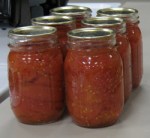 ring bands to wash the lid and jar to remove food residue. Then rinse and dry jars thoroughly. We recommend storing jars without ring bands. If mold does start to grow on them, or if seals are broken, you are more likely to notice this and won’t be surprised when you go to use the jar. The bands can also be washed and dried and stored separately for re-use later. At this point, it is the vacuum seal holding the lid tightly in place, not the ring band.
Label and date the jars and store them in a clean, cool, dark, dry place. For best quality, store between 50 and 70 °F. in low humidity. Even with cleaned and dried jars, dampness may corrode metal lids. Enough corrosion and you could even lose your seal.
Do not store jars above 95° F or near hot pipes, a range, a furnace, in an un-insulated attic, or in direct sunlight. These conditions may hasten loss of quality during storage. Dampness may corrode metal lids, break seals, and allow recontamination and spoilage.
For more on recommended canning procedures, visit the National Center for Home Food Preservation.

 Preserving Food at Home
You must be logged in to post a comment.