Category Archives: Uncategorized

Be Safe When Using Frozen Foods

hereMany of us use our freezers to put up goodies from the frozvegfresh harvest season. Others use the freezer to put together homemade meals or recipes ready to be cooked or reheated when cooking from scratch just is not on our schedule for the day or week. Freezing prepared foods in advance allows us the satisfaction of homemade meals with the convenience of store-bought ones.
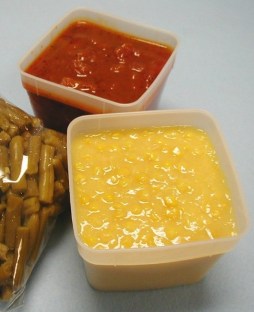
Freezing foods does not improve on poor texture, flavor or quality of foods, so choose your ingredients and products well. The way foods are prepared and packaged for freezing, as well as the temperature of the freezer, will greatly influence how well food will keep in the freezer. Quality in, quality out.

What I would like to emphasize is keeping food safe during thawing and later use out of the freezer. Several options are available for thawing prepared foods. The frozen food can be taken directly from the freezer and immediately placed in the oven for thawing and heating as long as it is in a freezer-to-oven safe container. Some foods are best reheated using a double boiler and can be thawed that way also. Foods that contain fish, meat, eggs or other high protein ingredients should be thawed in the refrigerator or microwave. To ensure the safety of your food, do not allow these potentially hazardous foods to stay in the temperature danger zone (40°F-140°F) for more than 2 hours. Plan ahead because refrigerator thawing can take some time. If you thaw potentially hazardous foods in the microwave, you should go ahead and finish the cooking and not store the thawed food as is.  The cooking can be done in the microwave itself, or using other cooking methods.

Breads, cakes, and cookies without cream fillings that are precooked may be thawed at room temperature. Reheat all prepared foods except non-meat baked goods, sweets and fruits to at least 165°F quickly, within 2 hours. Specifics for different kinds of foods can be found in Freezing Prepared Foods.  Other freezing pointers on thawing, packaging, freezer management, and foods that do not freeze well can be found here.

Planning ahead and freezing prepared foods is a great way to keep homemade food on your dinner table without all of the stress and hassle of last minute preparation. But be sure to keep food safety in mind when it’s time to serve your goodies.

Think sunshine and oranges in winter

We do not have a lot of our home canning recommendations that call for commercially processed ingredients in the recipes. However, here is an idea that does not require the fresh tomatoes, vegetables or fruits fresh from gardens. Just in the last week, I have had two people spontaneously say how much they like this recipe; in one case, it was an educator who said her canning class liked it a lot!

Orange Jelly from Frozen Juice  calls for one
12-ounce can of frozen concentrated orange juice and 1 traditional “box” of powdered pectin and creates a delightful, flavorful orange jelly for toast or biscuits on dreary winter mornings or late afternoons. The recipe yields five or size half-pint jars (we never all seem to get the same quantity for many recipes, do we? Or a final amount that just fills all jars exactly….)

For this one, we recommend using pre-sterilized jars and a very short boiling water process time. To pre-sterilize jars, boil empty, washed and rinsed glass canning jars submerged in boiling water for 10 minutes. (That’s 10 minutes after the water comes to a boil over the jars.) The easiest way to do this is to stand empty jars upright on a rack in a clean boiling water canner filled with clean water. Keep jars hot until they are filled. Prepare lids according to the manufacturer’s directions.

Directions for cooking the jelly are specific as to when to add sugar and pectin, and how long to boil. The process time in the canner is then 5 minutes up to 1000 ft altitude (10 minutes if 1,000-6,000 ft altitude; 15 minutes if over 6,000 ft). Allow jelly to cool, undisturbed, for 12 to 24 hours and check seals. You can remove ring bands after the food has cooled if the lids are sealed.

If you don’t want to pre-sterilize your jars, wash and rinse your jars and then keep hot before filling. The process times are then 10 minutes up to 1000 ft in altitude, (15 minutes if 1,000-6,000 ft altitude; 20 minutes if over 6,000 ft).

And enjoy the flavor of your labor, even if it really doesn’t take a lot time!

Do Those Sprouts Really Come from Brussels?

Probably not. Brussels sprouts may be grown in your very own home garden and still qualify as Brussels sprouts, though they are very popular and may have originated in Brussels, Belgium. Whether you actually have Brussels sprouts growing in your garden right now might depend on where you live and what the weather has been like this year, but as long as you have access to a grocery store with a healthy selection of seasonal vegetables, you can probably find some sprouts nearby. The best time to buy Brussels sprouts is between September and March. Brussels sprouts are notable not just for their unusual appearance, but also for their hardiness in cold weather. They are even said to be best when harvested after a couple of good freezes.

So it may not be surprising then that freezing Brussels Sprouts is a highly recommend method of preserving them. They will maintain best quality for up to 12 months in a 0°F freezer. To prepare them for freezing, select green, firm, and compact heads, removing any insects and course outer leaves. Wash well, then sort into small, medium, and large sizes if size variance is notable. Water blanch small heads for 3 minutes, medium heads for 4 minutes and large heads for 5 minutes. Cool them quickly in cold water or an ice bath, drain thoroughly, and package with no headspace. Then simply seal the containers and place in the freezer. To have properly proportioned serving sizes straight from the freezer and ready to be cooked, note that 5-6 sprouts equal one serving and/or one pound equals four servings.

If you’re feeling adventurous, then you might like also to try canning Pickled Brussels Sprouts. You may not have tried these before — the brine imparts flavor that is typical of many vegetable pickles while the texture is certainly more difficult to come by. Brussels Sprout pickles are made by boiling the clean sprouts in salt water (4 tsp canning salt per gallon), then cooling them while you prepare the brine that will be poured over the sprouts once they are in jars; the brine is a mixture of vinegar, sugar, onion, diced red pepper, mustard seed, celery seed, turmeric, and hot red pepper flakes. For the complete recipe, detailed instructions, and canning process time, see the recommendation in the link above. The same recipe and canning process is used for cauliflower too, so if you have some cauliflower flowerets around you could make both kinds (note that Brussels sprouts need to boil in the salt water for one minute longer than cauliflower).

Some of the information in this entry comes from Buying, Using, and Storing Vegetables from the University of Georgia.