Category Archives: Freezing

Apple Abundance

Apple jelly jarsIf your apple season is winding down with A LOT of apples, or if you stumble into a great sale at the grocery store, then you likely have enough apples to make apple juice and/or jelly!

First, prepare apples for extracting their juice. If you plan to make jelly and use purchased pectin, then you can use all ripe apples. If you are going to make jelly and rely on only the natural pectin in apples, then use ¼ slightly under-ripe apples and ¾ just ripe apples. Make juice in small batches – about 3 pounds of apples with 3 cups water will produce 4 cups apple juice. Sort the apples, discarding damaged portions. Wash the apples and cut them into pieces, but DO NOT remove skins or cores – the pectin is most concentrated in the skins and cores.

Now you’re ready to extract the juice. Place fruit into a flat-bottomed saucepan and add one cup water per pound of apples. Bring to a boil on high heat and stir to prevent scorching. Reduce heat and cook until soft, about 20 to 25 minutes. Be careful not to overcook; too much boiling will destroy the pectin, flavor, and color.

To clarify the juice, pour the entire contents of the saucepan into a damp jelly bag and suspend the bag so that the juice drains into a large bowl. For the clearest juice (and therefore the clearest jelly), do not press or squeeze the jelly bag.

using-a-jelly-bag

Once the juice is clarified, you may freeze it. Be sure to leave 1½-inch headspace and use a moisture-proof, durable freezer container. If you think you might use the juice for jelly, then do not presweeten it before freezing.

If you want to can the juice as is, follow these directions for canning Apple Juice in a boiling water canner. (Note: you could also can local cider from a cider maker; try to can it within 24 hours after being pressed.)

Follow these directions if you want to use the juice in Apple Jelly without added pectin.

Refer to pectin product packaging and follow those directions if you prefer to make jelly with added pectin.

© Andress, E.L., Harrison, J.A., eds. (2006). So Easy to Preserve, 5th ed. Athens, GA: University of Georgia Cooperative Extension.
Preserving the Fickle Fig

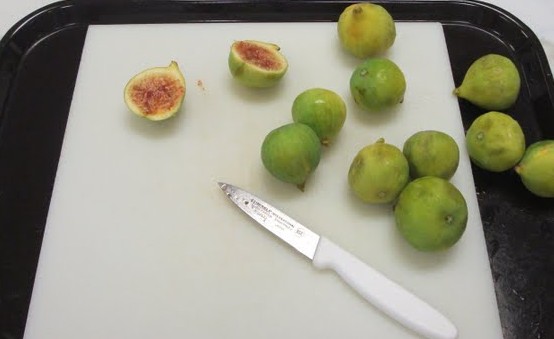
Whole and sliced figsFigs can be perfectly ripe when you pick them from the tree, then just a few days later they are notably far less appealing. With an extensive history of cultivation and consumption, fig trees provide us with fruit that is often preserved in order to extend its revered but fleeting qualities of flavor and texture.

Although a fruit, figs also display a borderline pH value for preserving as an acid food. Most fruits are clearly acid foods, with a pH below 4.6. (Vegetables, by the way, tend to be low acid foods, with pH values above 4.6.) Just a few fruits, figs among them, naturally range in pH right around 4.6, making them a borderline acid/low acid food since the pH can go above 4.6. Therefore, to be safely processed in a boiling water canner, some acid needs to be added to figs to keep them safe from botulism risk. You will see in the recommendations below that lemon juice or citric acid must be added, in the amounts called for, to home-canned fig products.  These acidification levels were determined through research.

Here are a few tested recommendations for preserving figs to try the next time you find yourself with fresh figs on your trees, or in your hands:

Fig Preserves is the recipe to use if you want to keep the plump fruits whole. This is a traditional southern-style whole fruit preserves, not a spread like jam. Fig Jam without added pectin directs you to chop the figs, and contains less sugar and less lemon juice than its crushed-fruit, pectin-added counterpart, Fig Jam with liquid pectin. If you’re willing to mix fruit flavors, then you might like to try Strawberry-Fig Preserves, which uses gelatin to help obtain a gel.

Another option for canning is to make Fig Pickles!

You may also choose to Freeze your figs. Unlike when canning, acid does not need to be added to figs in order to safely freeze them. However, it is suggested that lemon juice or ascorbic acid is added for the purpose of preventing discoloration and maintaining the highest quality of the figs.

Fresh fig halves on dryer trayFigs are excellent fruits for drying. To dehydrate figs, select fully ripe fruit and wash or clean the whole fruit with a damp cloth. Leave small fruit whole, and cut larger fruit in half. You should pretreat figs to be left whole by “checking” them.  Dip them in boiling water for 30 seconds or until skins split, then plunge them in ice water to stop further cooking. Be sure to drain them well on paper towels before loading them onto dehydrator trays and drying them for 6 to 12 hours.  The moisture inside the figs needs an escape route for drying out before intact skins would get too tough and dry.

Dried green figs

To learn more about dehydrating, please read Preserving Food: Drying Fruits and Vegetables.

So long Summer Squash…see you this winter!

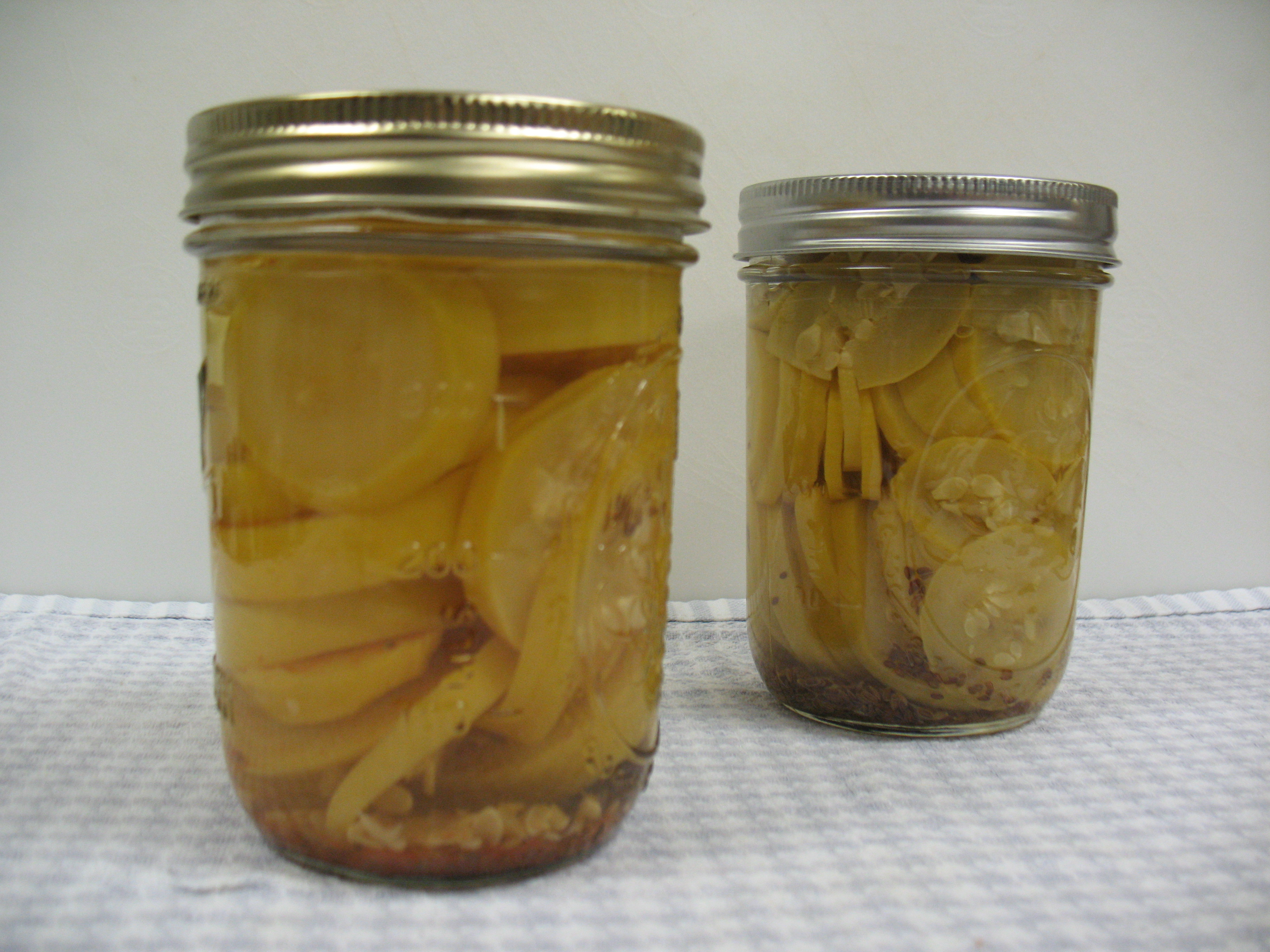
Squash PicklesSo, if you’ve already grilled squash outside for a cook-out, prepared stir-fry with squash, enjoyed a delicious squash casserole, and even fried squash blossoms, then you might be wondering what else you can do with the summer squash that’s still coming in. Preserve it!

One tasty option is to make Squash Pickles, following these recommendations from USDA/University of Georgia:

Recipe makes about 5 pint jars.

Ingredients:

4 pounds summer squash (or zucchini)

½ cup canning salt

1 quart vinegar (5%)

1 cup water

Dill seed (1 teaspoon per pint)

Garlic (1 clove per pint, if desired)

Procedure:

Wash squash, remove ends and slice into rounds. Pack garlic, dill seed, and squash into jars, leaving ½-inch headspace. Bring vinegar, water, and salt to a boil; simmer for 5 minutes. Fill jars to ½ inch from top of jars with the boiling hot liquid. Remove air bubbles and check that headspace is still ½-inch. Wipe jars rims and apply lids as directed by manufacturer. Process 15 minutes in a boiling water bath (remember to make altitude adjustments as needed). For a crisper product, you may want to add an agent such as crisping products containing calcium chloride.

Generally you CANNOT safely make substitutions in tested recipes, but there are a few noted exceptions.  USDA does support the substitution of summer squash for cucumbers in this recipe for Bread-and-Butter Pickles, which you might like if you prefer a sweeter flavored pickle.  If you are not a fan of pickles, then you may prefer to include summer squash as a substitute for zucchini in the recipe for canning Mixed Vegetables .

Zucchini PicklesCanning summer squash (without pickling) is not recommended, so if you prefer the flavor of plain squash, follow these directions for Freezing Summer Squash.

Recipe from So Easy To Preserve, edited by Elizabeth Andress and Judy Harrison, printed 2011.

Corn: On or Off the Cob

There’s nothing like eating fresh, flavorful corn-on-the-cob, grilled outside on a breezy summer day. But if you want to preserve some of that classic summertime treat for other seasons as well, then you might like to know about a few different ways to freeze corn.

Whichever freezing method you choose, select only tender, freshly-gathered corn in the milk stage. The milk stage is recognizable by plump kernels and a milky white fluid that secretes from cut kernels. (Some people even eat the kernels raw at this stage since this is when they are most sweet and moist). Husk and trim the ears, remove silks and wash well.

Blancher

Freezing Corn-on-the-cob is the only way to still bite it directly off the cob after freezing, but it is likely to become water-logged and mushy because it takes longer to blanch, freeze, and re-heat due to the presence of the dense cob. To freeze corn-on-the-cob, water blanch small ears (1¼ inches or less in diameter) for 7 minutes, medium ears (1¼ to 1½ inches in diameter) for 9 minutes and large ears (over 1½ inches in diameter) for 11 minutes. Cool promptly and completely to prevent a “cobby” taste. Drain and package. Seal and freeze.

Freezing Whole Kernel Corn is likely to produce crisper kernels than corn-on-the-cob, but must be eaten with a utensil or used as an ingredient in a recipe. To freeze whole kernel corn, water blanch 4 minutes. Cool promptly, drain and cut from cob. Cut kernels from cob about 2/3 the depth of the kernels. Package, leaving ½-inch headspace. Seal and freeze.

headspace_creamcorn

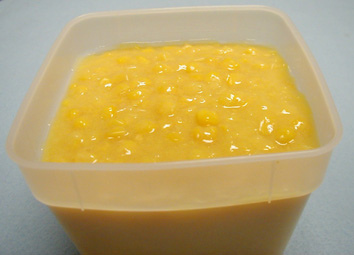
Freezing Cream Style Corn creates a creamy texture as a backdrop for the crisp kernels which stands alone as a side dish quite well, but does not necessarily mix into other recipes as well as whole kernel corn. To make cream style corn, water blanch 4 minutes. Cool promptly and drain. Cut kernel tips and scrape the cobs with the back of a knife to remove the juice and the heart of the kernel. Package, leaving ½-inch headspace. Seal and freeze.

Another way to prepare cream style corn for freezing is to cut and scrape the corn from the cob without blanching. Place the cut corn in a double boiler, and heat with constant stirring for about 10 minutes or until it thickens; allow to cool by placing the pan in ice water. Package, leaving ½-inch headspace. Seal and freeze.

These recommendations come from So Easy to Preserve and are also available on the NCHFP website. More freezing tips can be found at http://nchfp.uga.edu/how/gen_freeze.html.