 Asparagus!
Commercial production of the popular vegetable Asparagus officinalis harvests primarily from January to June, but its growing season across the U.S. is likely to begin closer to mid-April and last 6 to 8 weeks. Asparagus is unique in that you have to wait about 3 years from seed planting until first harvest, so make sure you do your research before growing it for the first time. Once you do get your hands on some fresh spears, one way or another, here’s a delicious way to make them last all year:
Pickled Asparagus
For six wide-mouth pint jars
10 pounds asparagus
6 large garlic cloves
4½ cups water
4½ cups white distilled vinegar (5%)
6 small hot peppers (optional)
½ cup canning salt
3 teaspoons dill seed
- Wash and rinse canning jars; keep hot until ready to use. Prepare lids according to manufacturer’s directions.
- Wash asparagus well, but gently, under running water. Cut stems from the bottom to leave spears with tips that fit into the canning jar with a little less than ½-inch headspace. Peel and wash garlic cloves. Place a garlic clove at the bottom of each jar, and tightly pack asparagus into jars with the blunt ends down.
- In an 8-quart Dutch oven or saucepot, combine water, vinegar, hot peppers (optional), salt and dill seed. Bring to a boil. Place one hot pepper (if used) in each jar over asparagus spears. Pour boiling hot pickling brine over spears, leaving ½-inch headspace.
- Remove air bubbles and adjust headspace if needed. Wipe rims of jars with a dampened, clean paper towel; apply two-piece metal canning lids.
- Process in a boiling water canner according to the recommendations in the table below. Let cool, undisturbed, for 12 to 24 hours and check for seals.
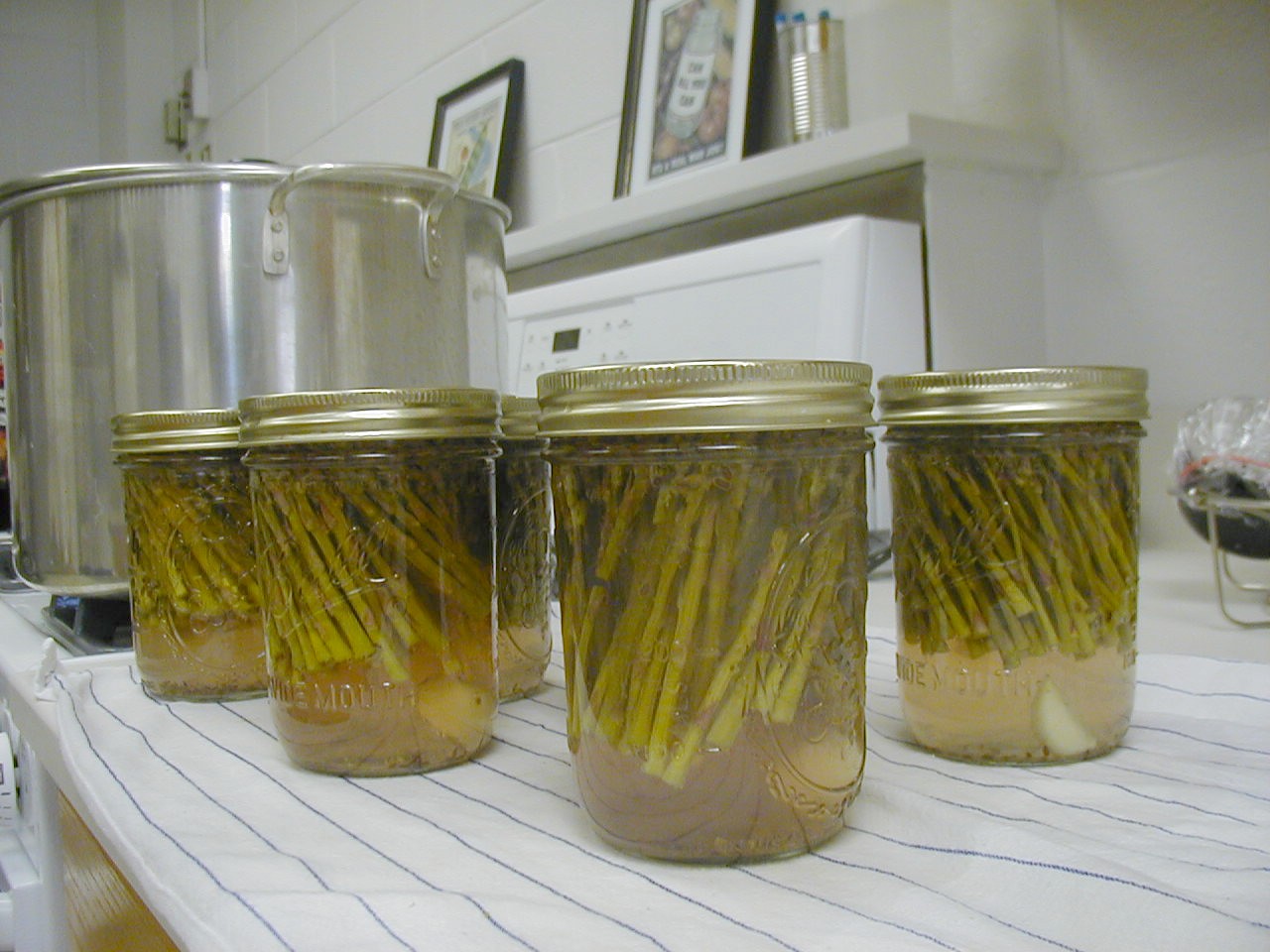 Allow pickled asparagus to sit in processed jars for 3 to 5 days before consumption for best flavor development.
| Recommended process time for Pickled Asparagus in a boiling-water canner. | ||||
|
Process Time at Altitudes of |
||||
|
Style of Pack |
Jar Size |
0 – 1,000 ft |
1,001 – 6,000 ft |
Above 6,000 ft |
|
Raw |
12-ounce or Pints |
10 min |
15 |
20 |
Visit the NCHFP website for recipe quantities to make seven 12-ounce jars and links to more information about Using Boiling Water Canners and Principles of Home Canning.
Recipe developed at The University of Georgia, Athens, for the National Center for Home Food Preservation. Released by Elizabeth L. Andress, Ph.D., Department of Foods and Nutrition, College of Family and Consumer Sciences. October 2003.

 Preserving Food at Home
You must be logged in to post a comment.