There’s nothing like eating fresh, flavorful corn-on-the-cob, grilled outside on a breezy summer day. But if you want to preserve some of that classic summertime treat for other seasons as well, then you might like to know about a few different ways to freeze corn.
Whichever freezing method you choose, select only tender, freshly-gathered corn in the milk stage. The milk stage is recognizable by plump kernels and a milky white fluid that secretes from cut kernels. (Some people even eat the kernels raw at this stage since this is when they are most sweet and moist). Husk and trim the ears, remove silks and wash well.

Freezing Corn-on-the-cob is the only way to still bite it directly off the cob after freezing, but it is likely to become water-logged and mushy because it takes longer to blanch, freeze, and re-heat due to the presence of the dense cob. To freeze corn-on-the-cob, water blanch small ears (1¼ inches or less in diameter) for 7 minutes, medium ears (1¼ to 1½ inches in diameter) for 9 minutes and large ears (over 1½ inches in diameter) for 11 minutes. Cool promptly and completely to prevent a “cobby” taste. Drain and package. Seal and freeze.
Freezing Whole Kernel Corn is likely to produce crisper kernels than corn-on-the-cob, but must be eaten with a utensil or used as an ingredient in a recipe. To freeze whole kernel corn, water blanch 4 minutes. Cool promptly, drain and cut from cob. Cut kernels from cob about 2/3 the depth of the kernels. Package, leaving ½-inch headspace. Seal and freeze.
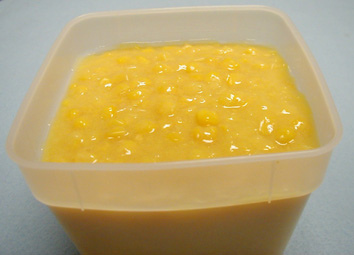
Freezing Cream Style Corn creates a creamy texture as a backdrop for the crisp kernels which stands alone as a side dish quite well, but does not necessarily mix into other recipes as well as whole kernel corn. To make cream style corn, water blanch 4 minutes. Cool promptly and drain. Cut kernel tips and scrape the cobs with the back of a knife to remove the juice and the heart of the kernel. Package, leaving ½-inch headspace. Seal and freeze.
Another way to prepare cream style corn for freezing is to cut and scrape the corn from the cob without blanching. Place the cut corn in a double boiler, and heat with constant stirring for about 10 minutes or until it thickens; allow to cool by placing the pan in ice water. Package, leaving ½-inch headspace. Seal and freeze.
These recommendations come from So Easy to Preserve and are also available on the NCHFP website. More freezing tips can be found at http://nchfp.uga.edu/how/gen_freeze.html.


 Preserving Food at Home
You must be logged in to post a comment.